Halloween III: How the Franchise's Most Hated Sequel Became a Cult Classic
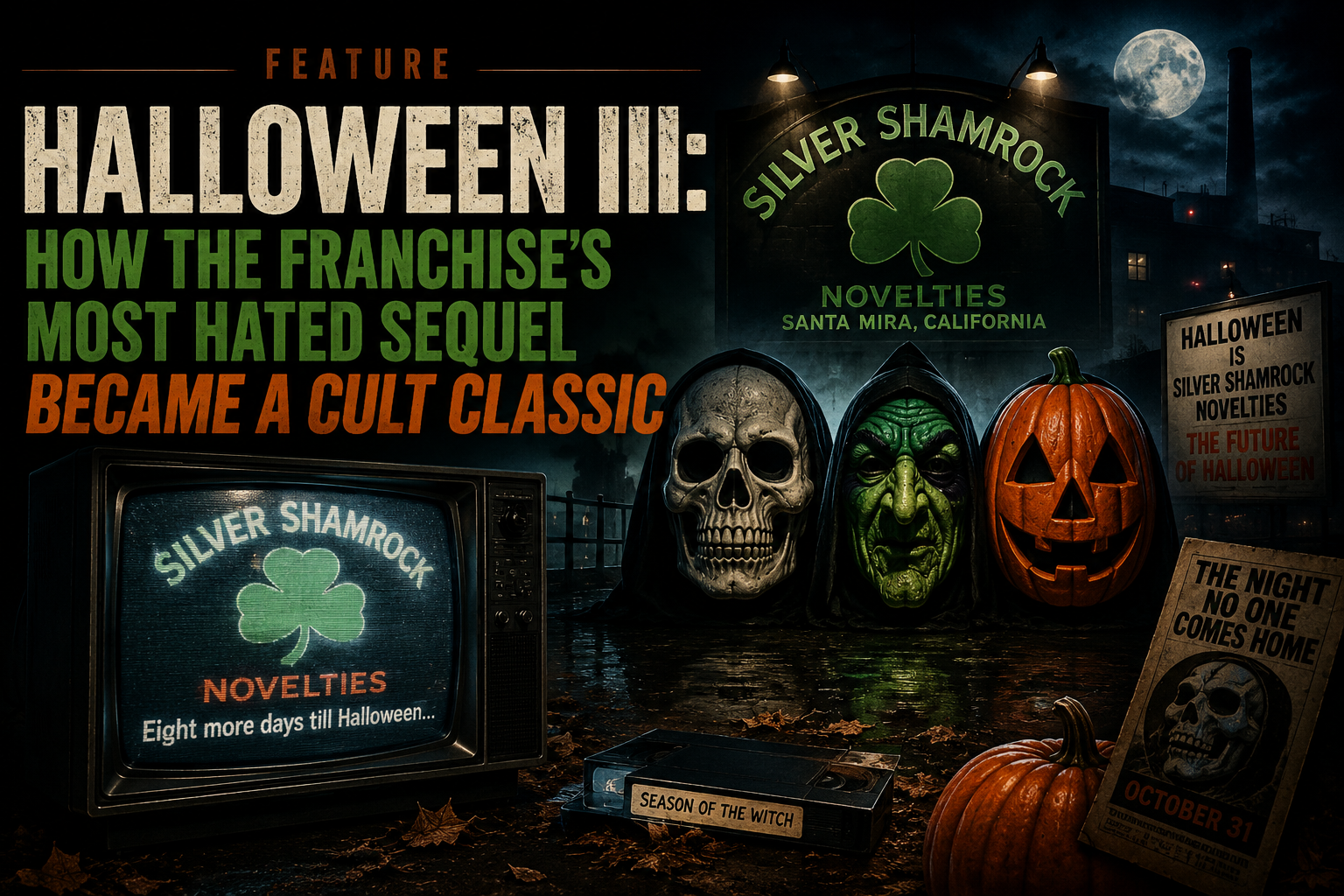
It removed Michael Myers and replaced him with killer Halloween masks, androids, Stonehenge, and the most irritatingly catchy advert in horror history. In 1982, Halloween III: Season of the Witch was the sequel many fans didn't want. More than four decades later, it might be one of the franchise's most interesting films.
STAFF PICK
ONE MORE MOVIE?
FEATURE PRESENTATION
STORIES WORTH REWINDING
FEATURE PRESENTATION
PLAY // READ // REWIND
PLEASE REWIND
Introduction
There are brave movie decisions.
There are stupid movie decisions.
And then there's making the third Halloween film without Michael Myers.
You have to admire the nerve.
By 1982, audiences knew what the name Halloween meant.
Michael Myers.
The white mask.
The kitchen knife.
Haddonfield.
John Carpenter's original created one of horror cinema's great monsters; Halloween II continued his story, and anyone buying a ticket for something called Halloween III could reasonably assume Michael would be waiting for them.
He wasn't.
Instead, they got a doctor named Daniel Challis.
A novelty company.
Three Halloween masks.
Robots.
Ancient Celtic ritual.
A stolen piece of Stonehenge.
Television signals that can do extremely unpleasant things to children.
And a song.
Oh God.
That bloody song.
🎵 Eight more days till Halloween...
If you know, you know.
And if you don't, congratulations on having several peaceful hours ahead of you before it becomes permanently lodged inside your skull.
Halloween III: Season of the Witch didn't merely take the franchise in a different direction.
It drove it off the road, through a hedge and into an entirely different genre.
Audiences weren't ready.
For years, Halloween III was treated like the franchise's embarrassing relative.
The one without Michael.
The weird one.
The mistake.
Except something happened.
People kept watching it.
Then they started defending it.
Then people who'd spent years being told it was rubbish discovered that it was actually...
really bloody interesting.
More than four decades after its release, Halloween III hasn't changed.
THE ELEPHANT NOT IN THE ROOM
Where the Hell Is Michael Myers?
You can't talk about Halloween III without dealing with Michael.
Or rather...
the complete absence of him.
After Halloween II, John Carpenter and Debra Hill weren't particularly interested in simply repeating the Michael Myers formula again.
Instead, they wanted to transform Halloween into an anthology.
Different stories. Different characters. Different threats.
One connection:
Halloween night.
Each new film could tell another strange or frightening story associated with October 31.
It's actually a cracking idea.
Today we'd probably praise somebody for trying something that ambitious with an established horror property.
In 1982?
People wanted Michael Myers.
Bloody Disgusting's retrospective on the film describes Carpenter and Hill's plan as a series of unrelated Halloween stories, with Season of the Witch becoming the first attempt at that new direction.
One fairly significant problem remained.
Nobody had explained to audiences that Halloween no longer meant Michael Myers.
So imagine turning up expecting The Shape.
The lights go down.
The movie starts.
You wait.
And wait.
And eventually realise...
He isn't coming.
THE TITLE
Calling It Halloween III Was Probably Half the Problem
Here's an interesting experiment.
Take Halloween III off the title.
Leave Season of the Witch.
Now imagine discovering exactly the same movie in the horror aisle of a video shop.
Tom Atkins. Creepy masks. A mysterious factory.
An evil Irish businessman. Robotic henchmen. Stonehenge.
A plot to murder enormous numbers of children through Halloween masks activated by a television broadcast.
You'd probably think:
What the hell is this? I've got to see it.
But put Halloween III above it and suddenly you're asking a completely different question.
Where's Michael?
That's the baggage the movie carried.
It wasn't simply being judged as a horror film.
It was being judged against an expectation it had deliberately refused to fulfil.
That's a difficult fight for any movie to win.
SILVER SHAMROCK
Then There's That Bloody Jingle
Some horror themes make your skin crawl.
John Carpenter's Halloween theme.
The music from The Exorcist.
Those two notes from Jaws.
And then there is...
Silver Shamrock.
The film takes the melody of “London Bridge Is Falling Down” and turns it into an advertising jingle counting down the days until Halloween.
It should be ridiculous. Actually, scratch that.
It is ridiculous.
But that's why it works. The advert appears again.
And again.
And again.
Until something designed to sell children's masks begins to feel threatening.
That's one of Halloween III's cleverest ideas.
It corrupts something harmless.
A television advert. A catchy children's melody.
Halloween masks.
Things associated with fun become part of something horrible.
And decades later, what was probably driving audiences insane in the cinema has become one of the most beloved parts of the movie.
You don't simply remember Halloween III.
You hear it.
🎵 Three more days till Halloween...
Sorry.
THREE MASKS
Possibly the Greatest Horror Merchandise Ever Invented
Skull. Witch. Pumpkin. That's it. Three masks.
Simple enough that you could draw them from memory.
Distinct enough that horror fans immediately recognise them.
And somehow they've become nearly as important to Halloween III as Michael's white mask is to the rest of the franchise.
Modern releases still celebrate those designs. A recent 4K edition, for example, includes dedicated material examining the masks themselves, which says something about how strongly they've survived within horror culture.
That's one of the wonderful ironies of Season of the Witch.
The Halloween movie criticised for removing an iconic mask...
created three iconic masks of its own.
And unlike Michael's mask, the villain isn't wearing these.
They're being worn by children.
Which is considerably nastier once you understand what Silver Shamrock intends to do with them.
DAN CHALLIS
Horror's Most Unlikely Action Hero
Then we've got Dr Daniel Challis.
Played by Tom Atkins.
And Challis is wonderful precisely because he doesn't feel like the hero somebody would design for this story.
He's a doctor. He's divorced. He's fond of a drink.
He's hardly Father of the Year. He's certainly not Laurie Strode.
And somehow he ends up trying to prevent a nationwide occult technological massacre.
As you do.
Atkins brings exactly the right energy.
Challis spends much of the film looking like a bloke who went to work expecting a normal shift and now deeply regrets every decision that brought him to this moment.
He's not a superhero. He doesn't have special knowledge.
He's simply stumbled into something enormous.
And the deeper he investigates Silver Shamrock...
the stranger everything becomes.
SANTA MIRA
Something Is Very Wrong With This Town
One thing Halloween III doesn't get enough credit for is atmosphere.
Santa Mira feels wrong. Not dramatically wrong. Quietly wrong.
The factory dominates the town. People seem watched.
Businesses close according to company schedules.
Strange men stand around without saying much.
Everyone seems connected to Silver Shamrock.
It's almost corporate folk horror.
A company town where the company isn't simply employing everybody.
It appears to own reality.
And Challis and Ellie Grimbridge arrive as outsiders who slowly realise they've walked into somewhere they really shouldn't be.
There's a little Invasion of the Body Snatchers in the feeling.
A little conspiracy thriller.
A little science fiction.
A lot of horror.
And very little that resembles Halloween.
Which is exactly why it feels refreshing now.
CONAL COCHRAN
One of the Franchise's Strangest Villains
Then we meet Conal Cochran.
Played beautifully by Dan O'Herlihy.
Cochran isn't Michael Myers.
Thank God the movie doesn't try to create another Michael Myers.
He's something completely different.
Charming.
Intelligent.
Polite.
Utterly insane.
He's taken modern mass production and combined it with ancient ritual.
That's the central collision inside Halloween III.
Old magic and new technology.
Stonehenge and television. Witchcraft and factories.
Sacrifice and advertising.
The ancient festival of Samhain transformed into a national consumer event.
Cochran looks at modern Halloween — masks manufactured by the thousands and sold to children through television commercials — and decides to use the machinery of consumer culture to restore something much older and darker.
That's a far more interesting idea than Halloween III sometimes gets credit for.
STONEHENGE
Yes, They Actually Stole It
At some point, Halloween III decides that killer masks and robots aren't quite enough.
So Stonehenge gets involved.
Not metaphorically.
Someone has literally stolen a piece of Stonehenge and transported it to America.
Even Challis reacts approximately how any normal human being would.
How the hell do you steal Stonehenge?
Excellent question.
The film isn't particularly interested in answering it.
And you know what?
Good.
This is where Halloween III becomes magnificent.
When discussing cult movies, there's a temptation to pretend every ridiculous idea was secretly genius.
We don't need to do that.
Some of Halloween III is completely bonkers.
That's part of why we love it.
The movie commits to its insanity with such confidence that eventually you stop asking questions.
Stonehenge?
Fine.
Robots?
Absolutely.
Magic computer chips?
Why not?
Keep going.
WITCHCRAFT MEETS THE COMPUTER AGE
The Idea Was Stranger Than the Franchise Around It
The screenplay's history is almost as unusual as the finished movie.
Nigel Kneale — creator of Quatermass — produced an early version of the story after Joe Dante had initially been considered to direct. The concept evolved through Carpenter and eventual director Tommy Lee Wallace, with accounts of the production describing the guiding idea as bringing witchcraft into the computer age.
That phrase explains Halloween III perfectly.
Witchcraft into the computer age.
The movie is obsessed with the collision between the ancient and modern.
Magic doesn't disappear because technology arrives.
It adapts.
The witch doesn't need a cauldron anymore. He's got a factory.
The curse doesn't have to be whispered.
It can be broadcast nationally.
And you don't have to lure children into the woods.
You can advertise directly to them on television. That's genuinely nasty.
THE TEST ROOM
Then Halloween III Shows You What the Masks Actually Do
For much of the movie, Silver Shamrock's plan is mysterious.
Then Cochran demonstrates it.
A family is placed inside a room.
A child wearing one of the company's pumpkin masks watches the special television broadcast.
And...
Well.
If you've seen it, you remember.
The sequence is where all the strange ingredients suddenly become horrifyingly clear.
The masks aren't symbolic.
The threat isn't theoretical.
This is what Cochran intends to happen to children across America.
It's bleak. It's grotesque.
And it gives the film an edge that perhaps gets forgotten beneath all the jokes about Stonehenge and the jingle.
Halloween III has a deeply nasty streak.
It just hides it beneath colourful masks and catchy advertising.
HAPPY HAPPY HALLOWEEN
The Movie Is Really About Advertising
There's another reason the film has aged surprisingly well.
Silver Shamrock doesn't need to force anybody to participate.
People buy the masks willingly.
Children demand them. Parents purchase them.
Television tells everyone what they need.
The company's biggest weapon isn't magic. It's marketing.
Silver Shamrock creates the product. Creates the desire.
Creates the television event.
Then gets millions of families to voluntarily sit in front of their screens at exactly the right moment.
That's quite a sinister idea for a movie released in 1982.
And perhaps it lands even harder now.
Cochran doesn't need to invade anybody's home.
We invite him in.
THE ENDING
STOP IT!
Then we get that ending.
Challis reaches the television station.
He's desperately trying to stop the Silver Shamrock broadcast.
One channel pulls the advert.
Another follows. And then... one remains.
Challis screams down the telephone.
STOP IT!
Again.
STOP IT!
And the movie ends. No comforting epilogue. No confirmation that everything worked out.
No little scene showing children safely removing their masks.
Just desperation.
Cut to black.
It's one of the strongest endings in the entire Halloween franchise.
Because the film refuses to tell us whether Challis succeeded.
Maybe the broadcast stopped. Maybe it didn't.
Maybe millions of children were still watching. Goodnight everybody.
Drive safely.
WRONG PLACE, WRONG TIME
Halloween III Arrived Before Audiences Were Ready for It
This is where history gets interesting.
The anthology idea didn't survive.
Michael Myers returned in 1988's Halloween 4: The Return of Michael Myers, and the franchise once again became his unmistakably. Retrospectives of Season of the Witch routinely point to its original rejection and the later reversal in fan opinion.
Which makes you wonder:
What if Halloween III had been Halloween II?
What if audiences had been told from the beginning that Halloween was an anthology?
What if Michael Myers had never been expected to return?
Could we have had decades of completely different Halloween stories?
One year a witch story. Next year, ghosts. Then monsters.
Urban legends. Haunted houses.
Something completely new every October. We'll never know.
But Season of the Witch gives us one fascinating glimpse at the franchise Halloween might have become.
THE VIDEO SHOP YEARS
VHS Gave Halloween III Another Chance
This is where time becomes a movie's best friend.
Opening weekends are brutal.
Expectation dominates everything.
But VHS didn't care what audiences expected in 1982.
Years later, somebody wandering through a video shop could pick up Halloween III knowing perfectly well Michael wasn't in it.
The betrayal was gone.
The surprise was gone.
Now you could watch the bloody movie.
And when people did...
some of them discovered there was quite a lot to like.
That's one of the wonderful things home video did for films.
It gave them another life. A movie could fail. Disappear.
Return on VHS.
Get watched by a completely different generation.
Then somebody would say:
Hang on. This isn't nearly as bad as everyone says.
And slowly a reputation could change.
THE CULT CLASSIC
Eventually Being the Weird One Became an Advantage
The very thing that hurt Halloween III eventually saved it.
It was different.
Think about the franchise today.
Michael returns again and again through competing timelines, remakes, reboots and alternate continuities.
Then sitting right in the middle of the shelf is this bizarre little anomaly.
No Laurie. No Loomis. No Michael. Just Silver Shamrock.
That makes it special.
When you're watching an entire Halloween marathon, Season of the Witch is almost a holiday.
Suddenly we're somewhere else—different mythology.
Different threat. Different movie.
The black sheep became the interesting one.
MAYBE WE WERE TOO HARSH
Horror Fans Are Very Good at Changing Their Minds
We've literally just been talking about this with our horror sequel piece.
Horror fans are excellent at reappraisal.
Give us enough time, and we'll reconsider almost anything.
Sometimes nostalgia helps.
Sometimes later sequels change the comparison.
Sometimes expectations disappear.
And sometimes we realise that a movie we rejected for what it wasn't deserves another chance for what it is.
That's exactly what happened with Halloween III.
It isn't secretly Halloween.
It doesn't need to be. It isn't a Michael Myers movie.
It never wanted to be.
Once you stop punishing it for that...
there's a wonderfully strange horror film underneath.
PLEASE REWIND
How Halloween III Became a Cult Classic
Maybe Halloween III: Season of the Witch committed the worst crime a sequel can commit.
It gave audiences something they hadn't asked for.
People wanted Michael Myers.
The filmmakers gave them Tom Atkins investigating a novelty company using Stonehenge-powered computer chips to kill children through Halloween masks.
You can understand the confusion.
But more than four decades later, that's exactly why the film survives.
Plenty of Michael Myers movies exist.
There is only one Season of the Witch.
Its masks became horror icons.
Its jingle became impossible to forget.
Its ending remains wonderfully bleak.
And its attempt to transform Halloween into an anthology remains one of the great cinematic roads not taken.
Was it misunderstood? Probably.
Was removing Michael Myers commercially disastrous?
Almost certainly. Is the movie occasionally ridiculous?
Oh, absolutely.
But that's the thing about cult movies.
Perfection isn't usually what makes us love them.
Personality does.
And Halloween III has enough personality for about six horror films.
Perhaps the movie didn't fail because it was a bad Halloween movie.
Perhaps it failed because audiences had already decided what a Halloween movie was supposed to be.
Forty-four years later, we can finally watch it without asking where Michael Myers is.
And what we've discovered is something horror fans should probably have realised a long time ago.
The night belongs to more than one boogeyman.
Whatever you do...
Don't watch the commercial.
🎵 Eight more days till Halloween...
Oh, bollocks.
END OF FEATURE
Be kind. Rewind. Then pick another.
One more movie?
DON'T RETURN
THE TAPE YET.
Two more stories from the Please Rewind magazine rack.
RENTAL_01
Movie Culture
How Cinema Has Changed in the Last 20 Years — And What We’ve Lost Along the Way
From Friday-night queues and packed multiplexes to streaming, phones and endless choice, going to the movies feels very different now.
PICK UP RENTAL →
RENTAL_02
Nostalgia
Whatever Happened to the Friday Night Movie?
Before endless scrolling and infinite watchlists, Friday night meant choosing one film, getting the snacks in and actually pressing play.
PICK UP RENTAL →