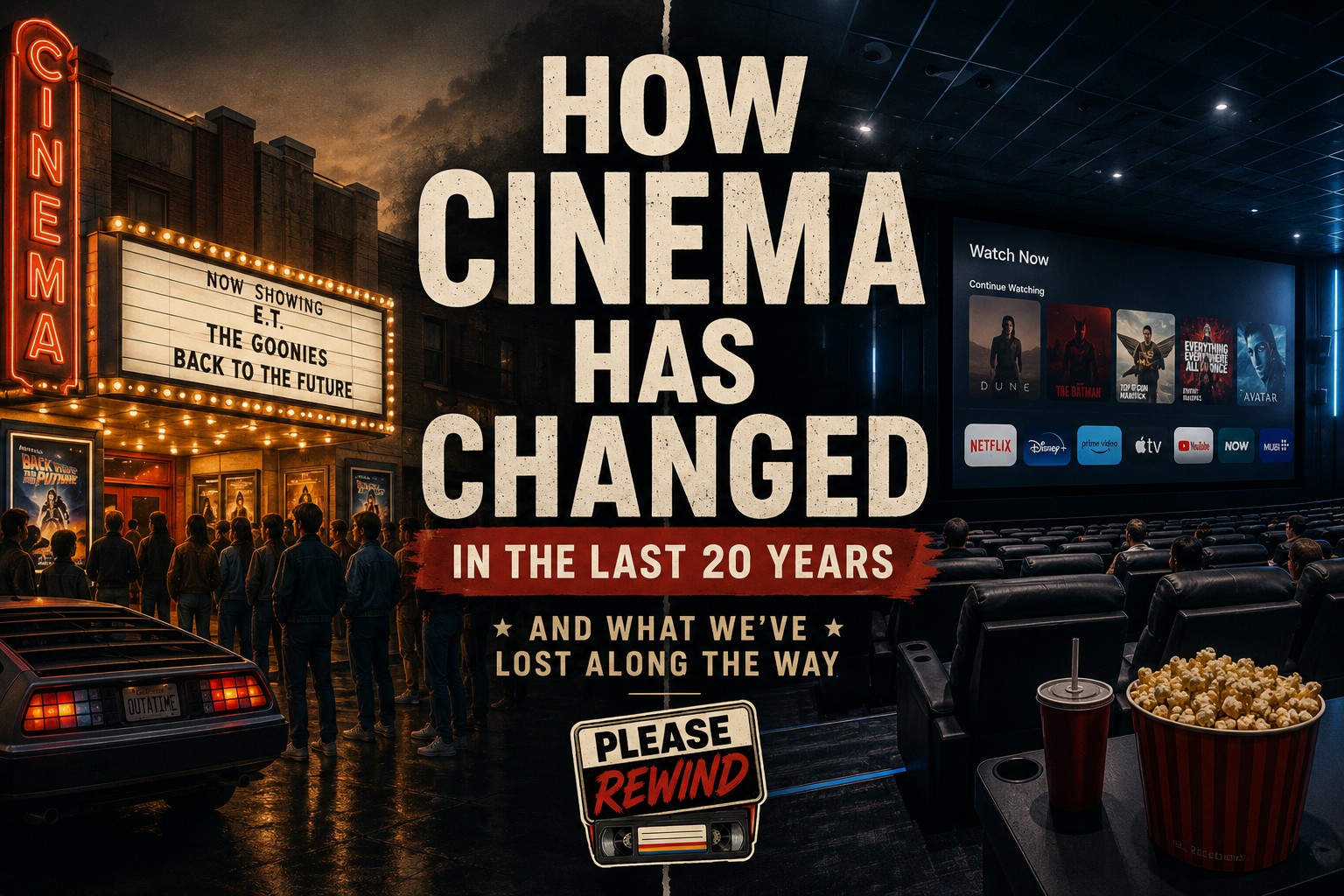
How Cinema Has Changed in the Last 20 Years — And What We’ve Lost Along the Way
From Friday-night queues and packed multiplexes to streaming, phones and endless choice, going to the movies feels very different now.
STAFF PICK
ONE MORE MOVIE?
FEATURE PRESENTATION
STORIES WORTH REWINDING
FEATURE PRESENTATION
PLAY // READ // REWIND
THEN & NOW
Twenty years does not sound that long — until you think about how we watched movies
Go back twenty years and the basic act of watching a film still felt strangely physical. You bought a ticket, stood in a queue, found your screen, sat through the adverts and trailers and watched the same movie at the same time as everyone else in the room.
At home, DVDs still mattered. A new release arriving on disc could feel like a second premiere. Shelves filled up, box sets became presents, and lending somebody a film meant physically handing it over and hoping you eventually got it back.
Today we can watch almost anything, almost anywhere, almost instantly. That is an extraordinary improvement in convenience. But convenience has changed the rhythm of moviegoing too.
The strange thing is that we gained access to more films than any generation before us and, somewhere along the way, individual films sometimes started to feel less important.
THE BIG SCREEN
The cinema used to feel like the first stop, not one option among twenty
For years the cinema had a simple advantage: if you wanted to see the new film everyone was talking about, you went to the cinema. There was no premium streaming rental waiting a few weeks later and no expectation that the movie might quietly appear on a subscription service before you had even stopped seeing adverts for it.
That made release dates matter. A big Friday opening could dominate conversations at school, work or the pub because huge numbers of people were seeing the same thing over the same weekend.
The cinema was not always cheap, the seats were not always comfortable and there was always somebody opening a packet at the quietest possible moment. But there was a sense that this was where a movie properly arrived.
Now the line between cinema release and home release is far blurrier. That is brilliant for people who cannot easily get to a cinema, but it has undoubtedly changed the feeling of urgency that once surrounded a major opening.
THE STREAMING AGE
Streaming gave us everything — and made choosing something harder
Streaming solved a problem we used to complain about constantly: access. No late fees. No scratched rental disc. No driving across town because the local shop had rented out every copy of the film you wanted.
Instead, we got giant libraries available from the sofa. On paper, that should have made movie night effortless.
Except something odd happened. Choice became its own problem.
We have all done it: twenty minutes scrolling through rows of thumbnails, adding things to a watchlist, reading descriptions, watching previews and somehow ending up watching nothing. The old video shop gave you fewer choices, but the limitations forced a decision.
The streaming menu is technically better in almost every measurable way. It is faster, larger and more convenient. Yet there was something useful about having to pick one film, carry it to the counter and commit to it.
DISTRACTIONS
The screen in your pocket became competition for the screen in front of you
Twenty years ago phones existed in cinemas, obviously, but they were not little entertainment centres permanently demanding attention.
Now a glowing screen two rows ahead can be more distracting than somebody coughing through the entire third act. Messages arrive, social media waits, notifications flash and the temptation to check something during a slower scene is always there.
That changes the experience in a subtle way. Movies are designed around attention. Suspense works because you stay with it. Comedy works because a room reacts together. Emotion works because the film has time to pull you into its world.
A cinema is still one of the few places left where we can give a story two uninterrupted hours. That feels more valuable now precisely because uninterrupted attention has become harder to find.
THE BLOCKBUSTER
Big movies increasingly became chapters rather than complete events
Sequels are hardly new. Hollywood has always loved a successful idea enough to make it again.
What changed was scale. Over the last twenty years, interconnected franchises, cinematic universes and long-running series became a dominant language of blockbuster filmmaking.
There is a huge pleasure in returning to characters and worlds you love. Done well, a series can build anticipation in a way a standalone movie cannot.
But there is also a difference between going to see a movie because the movie itself looks exciting and going because it is chapter fourteen of something you have been following for a decade.
Some of the old event movies felt enormous precisely because there was no homework. The poster, the trailer and a great premise were enough. You bought a ticket and stepped into a complete world for two hours.
COMING SOON
We used to know less about a movie before we saw it
There was a time when seeing a trailer at the cinema could genuinely be the first time you knew a film existed.
You might have seen a poster in a magazine or heard somebody mention it, but the information drip was slower. A trailer felt like a glimpse rather than one piece in a six-month content campaign.
Now we can see teasers for teasers, casting news, set photographs, reaction videos, breakdowns, leaked details and endless speculation long before release day.
That can be fun. Anticipation is part of being a movie fan. But surprise has become harder to protect.
Sometimes the greatest gift you can give yourself is to know the title, know the basic premise and stop there.
TAKE IT HOME
Owning a movie went from normal to almost rebellious
DVD shelves were once completely ordinary. You did not call yourself a collector because you owned fifty films. You just owned fifty films.
Streaming gradually turned ownership into access. Instead of deciding which film to buy, we decided which service to subscribe to.
The upside is obvious: for the price of a couple of discs you can access hundreds or thousands of titles. The downside is that access can disappear. Films move between services, editions change and something you assumed would always be there can simply vanish from a catalogue.
That is one reason physical media has become interesting again. Buying a favourite film on Blu-ray or 4K is no longer only about picture quality. It is about saying: this one stays on my shelf.
There is something deeply satisfying about that in an era when so much entertainment feels temporary.
WHAT REMAINS
For all the changes, a great cinema experience still works exactly the same
The lights still go down. The room still goes quiet. The studio logo still appears and, for a couple of hours, somebody else gets control of your attention.
A packed audience can still transform a comedy. A horror film can still become ten times more frightening when everyone around you is holding their breath. A huge action sequence can still make a television at home feel very small indeed.
That is why cinemas survive every prediction of their death. The technology changes. The business changes. The release windows change. The snacks get more expensive. But the basic magic is stubborn.
You sit in the dark with strangers and agree to care about the same imaginary people for a while.
PLEASE REWIND
Maybe what we lost was not better movies — it was the ritual around them
It is easy to turn nostalgia into a competition and insist that everything used to be better. It did not. We had terrible films, uncomfortable seats, expensive concessions, rubbish transfers and plenty of nights where the video shop had nothing worth renting.
What feels different now is the ritual.
Waiting for release day. Choosing one film. Buying the DVD. Reading the back of the box. Watching the trailers. Lending it to a mate. Seeing the same poster every time you passed the cinema.
Movies had more friction around them, and some of that friction created memories.
The challenge now is not to rewind twenty years and pretend streaming never happened. It is to keep the good part: choosing something deliberately, giving it our attention and letting a movie feel important again.
That, more than anything, is what Please Rewind is here for.
END OF FEATURE
Be kind. Rewind. Then pick another.
One more movie?
DON'T RETURN
THE TAPE YET.
Two more stories from the Please Rewind magazine rack.
RENTAL_01
Nostalgia
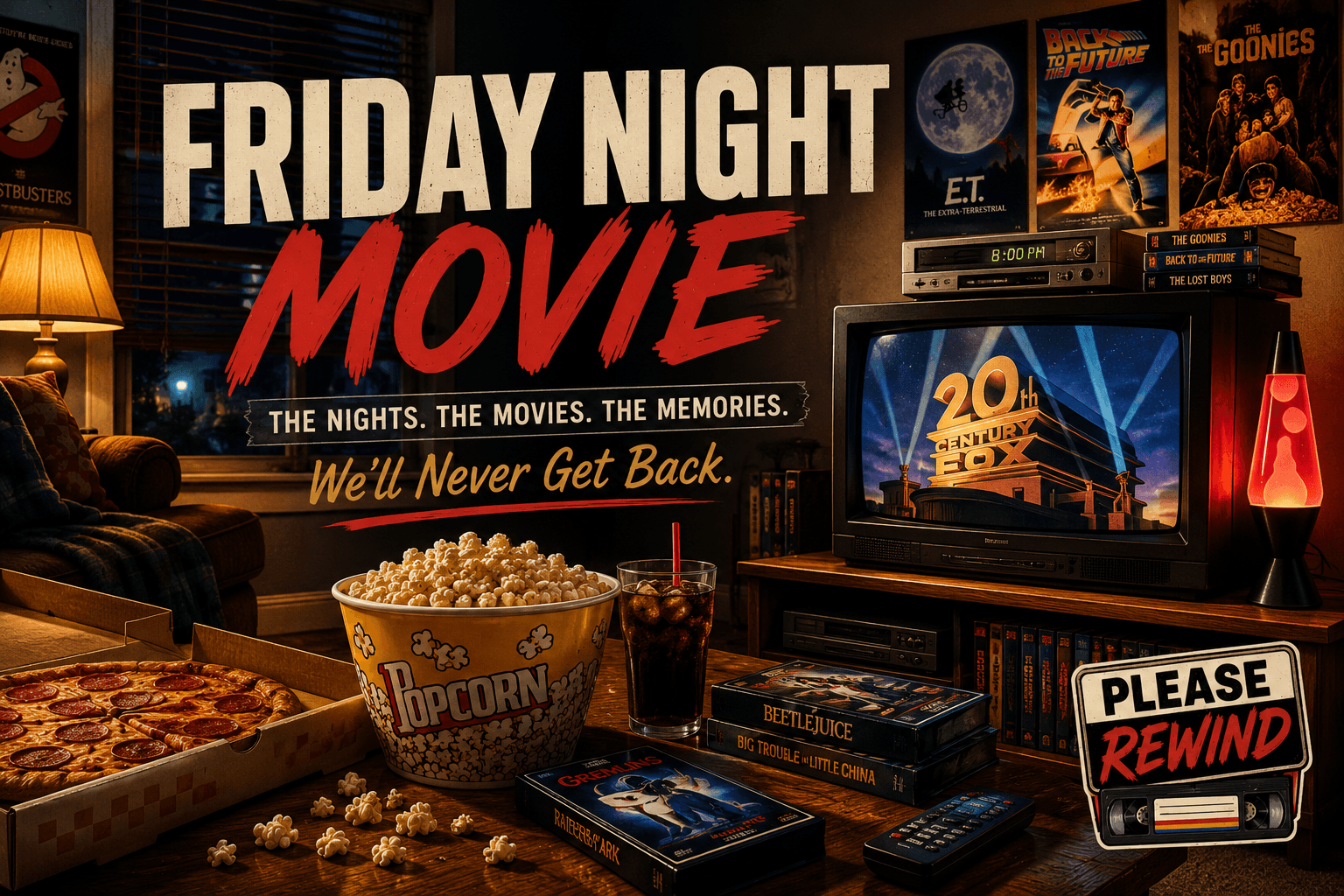
Whatever Happened to the Friday Night Movie?
Before endless scrolling and infinite watchlists, Friday night meant choosing one film, getting the snacks in and actually pressing play.
PICK UP RENTAL →
RENTAL_02
Movie Culture
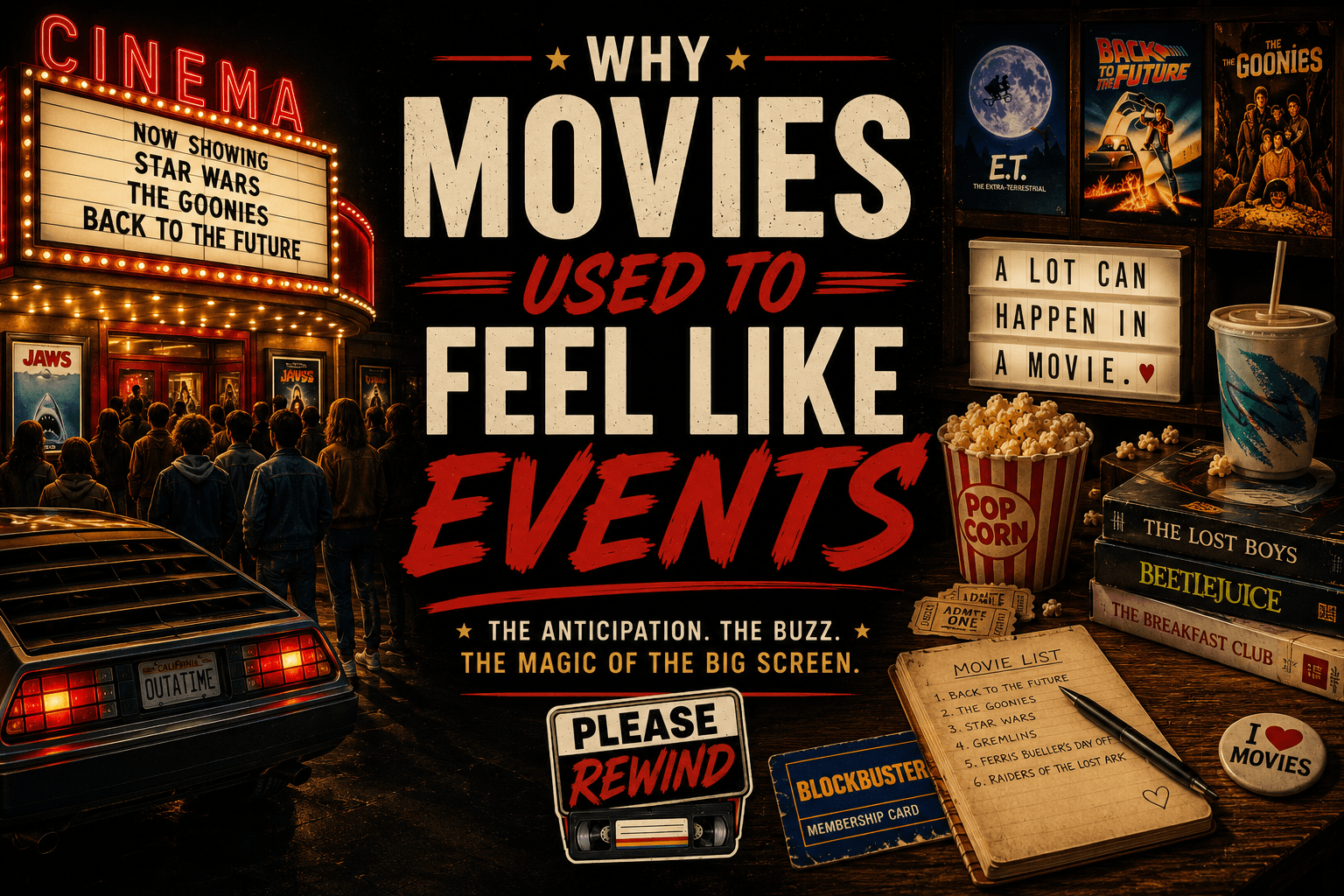
Why Movies Used to Feel Like Events
Posters, trailers, release-day queues and months of anticipation once made a new movie feel enormous. Have we lost that — or just changed how hype works?
PICK UP RENTAL →