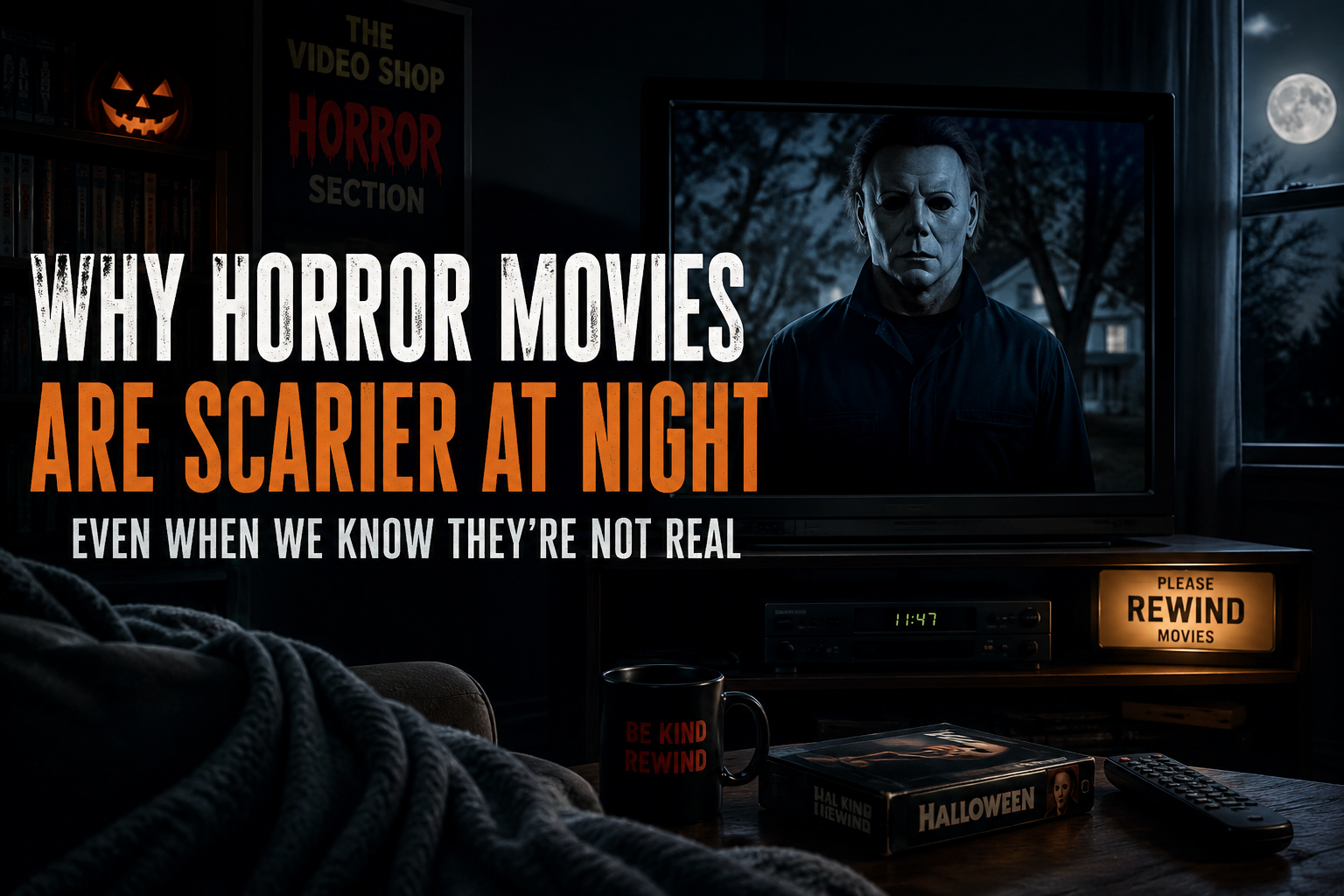
Why Horror Movies Are Scarier at Night — Even When We Know They’re Not Real
We know Michael Myers isn’t standing outside. We know the noise downstairs is probably the heating. And we know the film ends the same way whether we watch it at two in the afternoon or midnight. So why do horror movies become so much scarier after dark?
STAFF PICK
ONE MORE MOVIE?
FEATURE PRESENTATION
STORIES WORTH REWINDING
FEATURE PRESENTATION
PLAY // READ // REWIND
WHEN THE LIGHTS GO OUT
Darkness Gives the Movie More of the Room
Watching horror during the day creates a boundary between the film and reality.
The television might show a haunted house, a masked killer, or something unpleasant crawling out of a basement, but everything around the screen is reassuringly ordinary.
There is daylight coming through the curtains.
Cars are passing outside.
Somebody is cutting the grass.
The kettle is boiling.
The world is clearly carrying on.
At night, much of that disappears.
The room beyond the television becomes darker. Corners become harder to see. Reflections appear in windows. The hallway outside the room suddenly looks considerably longer than it did twenty minutes earlier.
Horror no longer exists inside a rectangle.
It starts leaking into everything around it.
YOUR BRAIN JOINS IN
The Dark Lets Our Imagination Finish the Job
One of horror's greatest special effects costs nothing.
It's whatever you think might be there.
Human beings aren't particularly good at looking into darkness and accepting that there is simply nothing to see.
We start filling in the blanks.
A coat hanging over a chair becomes a person for half a second. A shadow at the end of the hallway looks slightly wrong. Something outside catches the light and suddenly deserves considerably more investigation than it did earlier.
Good horror filmmakers understand this.
They don't always show us the monster.
Sometimes they show us the doorway where the monster could appear.
And once you're sitting in a dark house yourself, the movie has effectively given your imagination dozens more doorways to work with.
THE HOUSE HAS A SOUNDTRACK
Every Little Noise Suddenly Matters
Houses sound different at night.
Or perhaps we simply notice them more.
Pipes knock.
Floorboards move.
Radiators click.
Wind catches something outside.
The fridge decides midnight is the perfect time to make a noise you've somehow never heard it make before.
During the day, most of these sounds disappear into everything else happening around us.
After midnight, they get promoted.
You've just spent ninety minutes watching people make catastrophically bad decisions after hearing mysterious noises, and then something goes bang upstairs.
Logically, you know it's probably nothing.
Horror movies aren't particularly interested in logic.
HORROR KNOWS WHAT IT'S DOING
So Many Horror Movies Were Built for Darkness
Horror filmmakers keep returning to nighttime for a reason.
Darkness removes information.
We can't see what is at the end of the street.
We can't see what's standing behind the trees.
We can't see what's inside the bedroom until somebody opens the door.
Michael Myers becomes particularly effective because he can simply emerge from darkness.
A face can exist in the background without us noticing it right away.
A figure can stand beneath a streetlight while everything around them disappears.
Night gives filmmakers somewhere to hide things.
And what we can't see is often considerably more frightening than what we can.
THE MIDNIGHT PROBLEM
Being Awake When Everyone Else Is Asleep Feels Different
Another ingredient arrives with late-night horror.
Isolation.
At 3 pm, the world feels available.
Shops are open. People are outside. Phones are buzzing. Traffic is moving.
At 1 am, your little corner of the world can feel strangely abandoned.
Everyone else appears to have gone somewhere.
Even when you're perfectly safe at home, that changes the atmosphere.
And horror loves isolation.
The cabin in the woods.
The empty hospital corridor.
The deserted street.
The house where everyone else has gone to bed.
Watching late at night can recreate a tiny version of that feeling without us ever leaving the sofa.
DON'T LOOK BEHIND YOU
Horror Changes the Geography of Your Own House
This might be the strangest part.
A good horror movie can temporarily redesign somewhere you've lived for years.
The hallway you've walked through thousands of times becomes suspicious.
The kitchen window suddenly shows an alarming amount of blackness on the other side.
The staircase looks different when the lights downstairs are off.
And going to the toilet halfway through the film becomes an expedition that apparently requires turning on every available light between the sofa and the bathroom.
Nothing in the house has actually changed.
But the film has taught your brain what to look for.
For the next couple of hours, apparently that's everything.
WE LEARNT THIS YOUNG
Some of the Fear Comes From Childhood
For many horror fans, watching scary movies at night connects with something much older.
Being frightened of the dark.
Most of us eventually grow out of believing something lives underneath the bed.
We become adults.
We pay bills.
We drive cars.
We understand perfectly well that monsters aren't waiting inside wardrobes.
Then somebody puts The Exorcist, Halloween or The Ring on at midnight, and suddenly we're extremely interested in how quickly we can get from the light switch to the bed.
Horror gives adults permission to relive a childhood fear.
We know better.
For two hours, we choose not to.
THE VIDEO SHOP YEARS
Horror Night Used to Begin Before We Pressed Play
For those of us who grew up renting horror movies, the nighttime ritual often started hours before the film.
You'd choose the tape from the horror aisle.
Carry it home.
Leave it sitting beside the television.
Wait until later.
And somehow the movie became more intimidating as the evening got darker.
That VHS cover you'd been staring at in the shop now sat in your own house.
Eventually the curtains were closed, the lights went down, and the tape went into the machine.
No phones lit up every few minutes.
No second screen.
No scrolling while the film played.
For better or worse, you were in.
And if the movie frightened you, you still had to eject the tape afterwards.
WATCHING ALONE
One Empty Chair Can Make a Huge Difference
Horror is completely different with six friends in the room.
Someone makes a joke.
Someone predicts the jump scare.
Someone claims they aren't frightened while very obviously being frightened.
Fear becomes communal.
Watch the same film alone, and there's nobody there to puncture the tension.
Silence lasts longer.
Scenes feel slower.
And when something happens behind you in the house, no one else is there to confirm they heard it too.
That's when you discover how much courage apparently depends on somebody else being on the sofa.
SOUND DOES HALF THE WORK
Darkness Makes Us Listen Differently
Great horror isn't only something we watch.
It's something we listen to.
A distant footstep.
Breathing.
A door opening somewhere off-screen.
The faintest piece of music beginning underneath a scene.
When the room is dark and everything around us is quiet, those sounds become much more powerful.
We're paying attention differently.
And modern televisions, headphones and home sound systems can make that effect even stronger.
Sometimes the most frightening thing in the scene isn't visible at all.
It's somewhere behind you.
At least according to the speakers.
WE KNOW IT'S COMING
Knowing the Scare Doesn't Always Stop the Scare
This may be the best evidence that horror operates below simple logic.
We can know exactly what is about to happen and still react.
Fans rewatch Halloween knowing where Michael appears.
They rewatch The Exorcist knowing which moments are coming.
They know the rhythm of The Shining, the shocks in The Ring and the beats of countless slashers they've watched since they were teenagers.
Yet under the right circumstances, those movies still work.
Because suspense isn't always about what happens.
Sometimes it's about waiting for something you already know will happen.
Darkness gives that anticipation somewhere to grow.
SAFE FEAR
Being Scared Is Part of the Fun
Of course, there's an important difference between being genuinely frightened and watching a horror movie.
We can stop the film.
Turn the lights on.
Make a cup of tea.
Check the front door for the third time.
We're safe.
That safety is what makes horror enjoyable.
A dark room lets us move a little closer to the fear without actually being in danger.
It's controlled discomfort.
A roller coaster for the imagination.
And when the credits roll, the ordinary room gradually becomes ordinary again.
Usually.
THE RITUAL
Maybe Horror Is Supposed to Be Watched This Way
We spend a lot of time discussing which horror movies are scary.
Maybe we don't spend enough time talking about how we watch them.
A horror film at midday on a laptop, with messages popping up, isn't necessarily the same experience as watching it late at night, lights off, phone down, with nothing but the television illuminating the room.
Atmosphere matters.
Attention matters.
The environment matters.
Maybe that's why generations of horror fans instinctively wait until darkness before pressing play.
We're not simply watching the movie.
We're helping it.
THE PLEASE REWIND TAKE
The Movie Isn't Scarier at Night. We Are.
That's really the trick.
Michael Myers doesn't become more dangerous after sunset.
The ghost doesn't become more convincing.
The monster hasn't climbed out of the television.
We have changed.
There are fewer distractions.
Less visual information.
More silence.
More shadows.
More room for imagination.
And for a couple of hours, the comfortable house we've lived in for years becomes part of the movie.
That's one of horror cinema's greatest tricks.
It doesn't always need to convince us that the monster is real.
It only needs to make us wonder what made that noise in the hallway.
And whatever you do...
don't go and check.
END OF FEATURE
Be kind. Rewind. Then pick another.
One more movie?
DON'T RETURN
THE TAPE YET.
Two more stories from the Please Rewind magazine rack.
RENTAL_01
Movie Culture
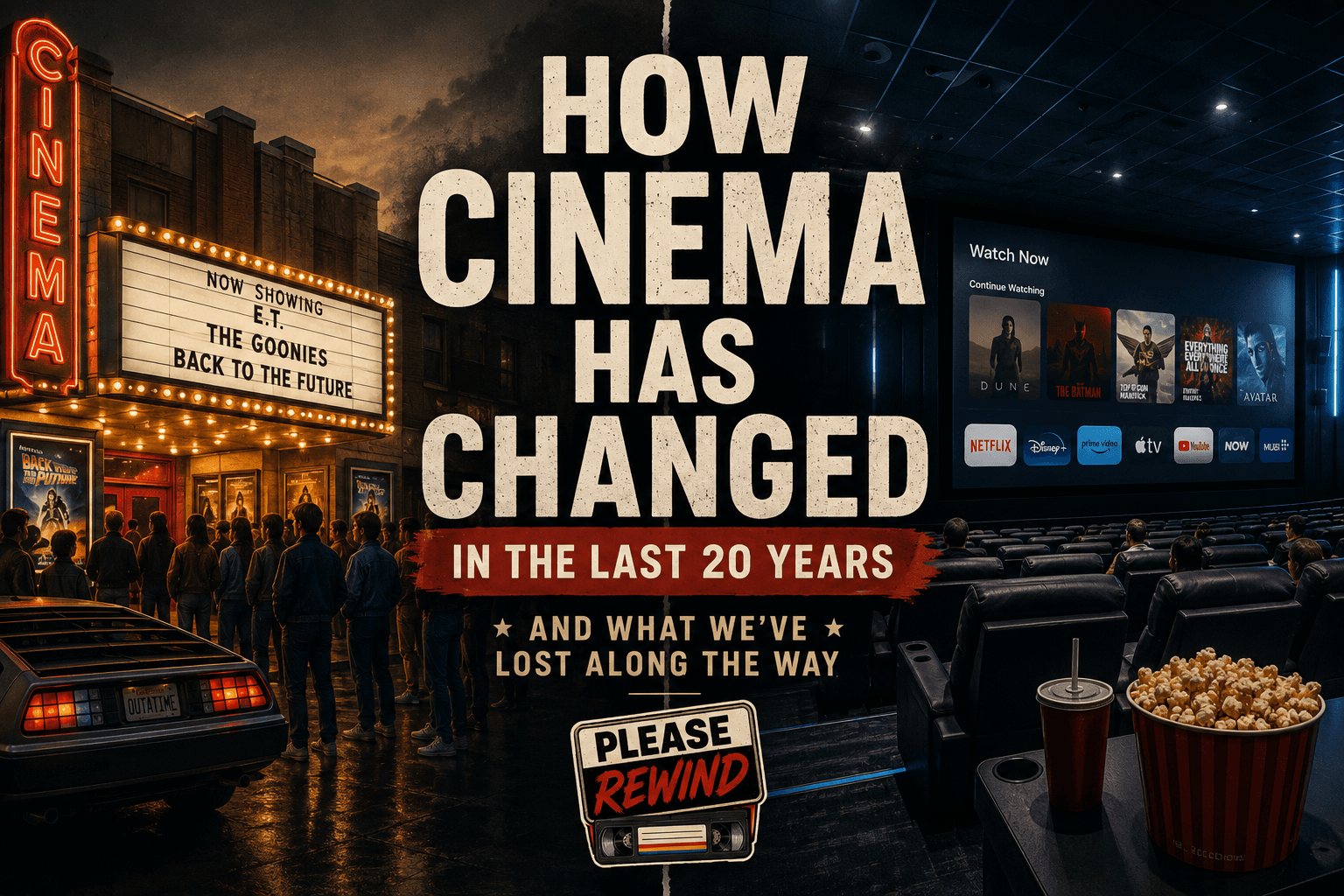
How Cinema Has Changed in the Last 20 Years — And What We’ve Lost Along the Way
From Friday-night queues and packed multiplexes to streaming, phones and endless choice, going to the movies feels very different now.
PICK UP RENTAL →
RENTAL_02
Nostalgia
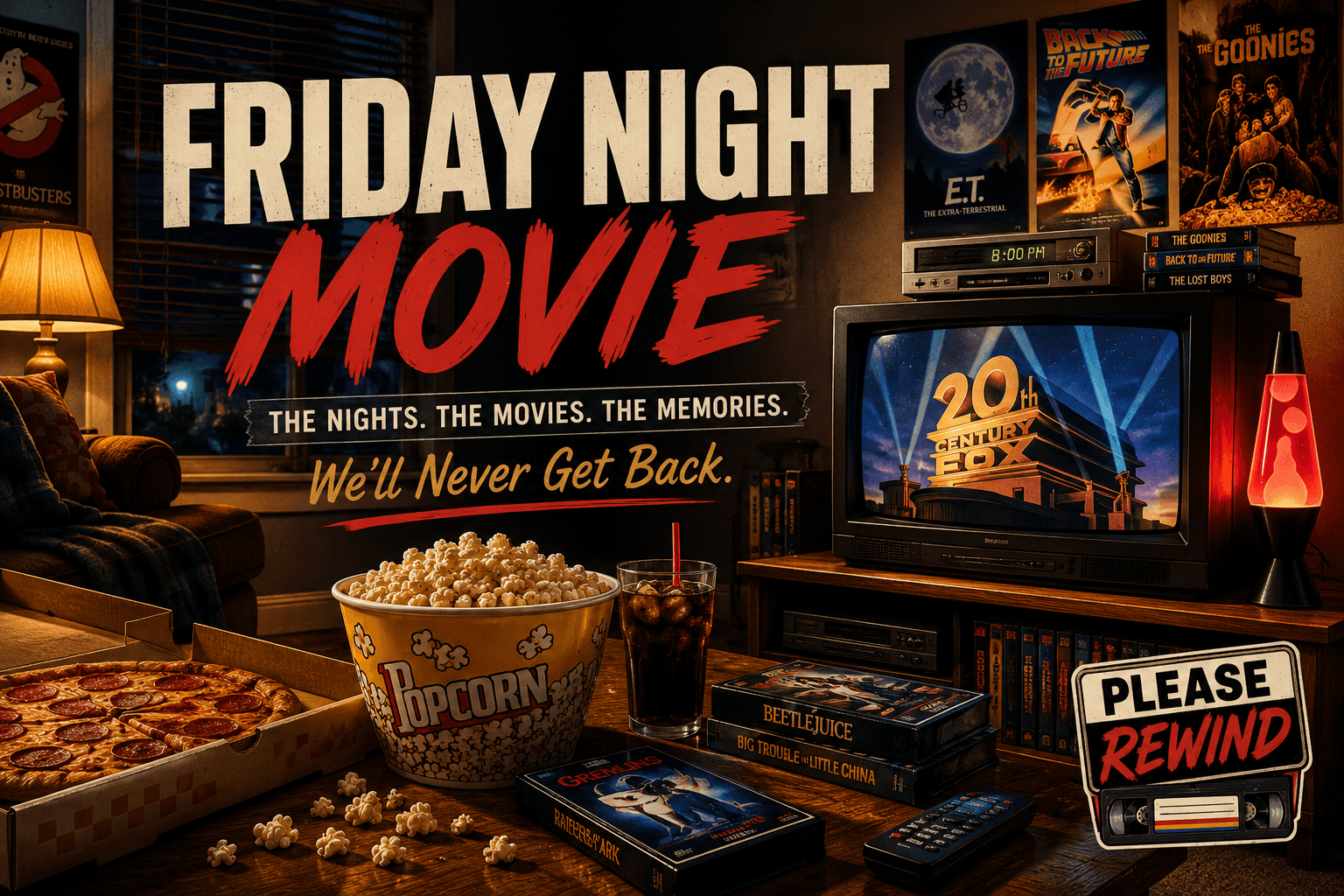
Whatever Happened to the Friday Night Movie?
Before endless scrolling and infinite watchlists, Friday night meant choosing one film, getting the snacks in and actually pressing play.
PICK UP RENTAL →